
Understanding American Politics for Beginners

There is a lot of disinformation out there. Basically, untrue statements are put out there as facts, and then faulty logic is used to rationalize them.

You can’t fact check everything even if you wanted to. And you don’t have the same resources as an investigative journalist. You have to protect your brain – once you have let a wrong idea in it will fester in there, even if you know it isn’t true, and it will influence your thinking.

So when you find a source of information that is deliberately producing disinformation, then stop using it. I’m not talking about being wrong because nothing is perfect. When a news source makes a mistake, if they deal with it appropriatly by apoligizing, and firing or reprimanding the people involved that is forgivable as long as it doesn’t happen too often.

It is also important to realize there is subconscious bias, and to take that into account when you are analyzing your news sources. If everyone working in a news organization are all aligned politically, then even if they produce 100% accurate and unbiased coverage, they just plain may not cover things that are of interest to people in different political parties because they don’t even realize they are important. This is ok – nothing is perfect – you just have to realize it is happening and try to find other ways to take different perspectives into account. What a news organization covers is not as important as how they cover it. If you can basically trust what they say then keep it.

Another way to recognize good news sources from bad news sources is the presentation. If you find yourself regularly being emotionally affected instead of informed, then you are at risk for being manipulated. If an organization is trying to manipulate you, and they know you are likely to encounter some facts that go counter to what they want you to believe, then they may try appealing to your patriotism or they may try distorting the facts to get an emotional reaction out of you. Once you are viewing the problems in an emotional way you have lost your ability to think rationally. Some “news” organizations present news in this fashion daily, as a deliberate attempt to misinform you.

One of the problems you will run into is that there are essentially two major world views in politics right now. Both parties are corrupt, but one is so bad it should be considered a terrorist organization. We should be able to agree on a set of facts, and from there have discussions about the best course of action. Because we have different viewpoints, when that happens, we can end up with good decisions that are compromises and meet the needs of both groups. That can’t happen now because the terrorist party has spent decades lying. You know how when you tell a lie, and then you almost get caught and so you tell another, and then you almost get caught and the only way to keep from getting caught for any of your past lies is to tell yet another? The terrorist party has been doing that for so long they are completely disconnected from reality. We no longer have a common set of facts we can agree on to start compromising. The “facts” the terrorist party believes are all made up lies. The problem for you, trying to figure out what to believe, is the two world views that creates. One is based in reality. But the one that is not has been fleshed out over decades. It is a nearly perfect imitiation of reality. So if you allow yourself to enter and THEN start fact checking, all you will be doing is checking one lie against another. And these lies have evolved to interlock, so I assume it can actually feel real. It must – that is the only way to explain the completely insane behaviour of the terrorist party.

Don’t commit to a world view before you have figured out which one is real. Don’t go in and “sample the waters” to see if you like one over the other. You risk poisoning yourself. Remember – half the country fervently believes a big ball of lies. This is undoubtedly true because if you ask a Democrat or a Republican if they believe the other side believes nonsense, I think most would agree. They just don’t agree which side it is. Don’t drink the water before you have made your decision, because if half the country believes the nonsense, it must be addictive.

And once you have made your decision, you won’t be easily able to change it. If five years after the fact you start to realize you have made a mistake then your brain will wash those thoughts from your head (research cognitive dissonance). The worldviews are so far apart you can’t really adjust an idea or two. If you realize you made the wrong decision then you would have to throw away your entire belief system and start over. That is a lot of energy and effort and so your brain will try to prevent you from doing it.
The best way to decide which world view is based on reality, is to determine which party is tethered to reality with facts.

These are some of the questions I asked myself as I was figuring this out:

  1. How do political parties that are trying to manipulate people’s thinking behave?

    The answer is that they try to control anyone with facts that oppose what they want you to believe. This means intellectuals, experts, the media, etc. Stalinist Russia did it, China did it during the people’s revolution, Hitler did it in Nazi germany, it happened in Cambodia. So which side tries to suppress intellectuals, experts, the media, and other sources of facts? Which side supports the experts behind climate science? Which side supports medical experts during our pandemic? Which side demonizes the press? Which side has no fact checking web sites? Which side contains more college professors? Which side contains more educated people?
  2. Do fact checking sites work?

    Fact checking sites exist only for one side. Are they reliable? I looked for lists of things the fact checking sites got wrong. Not one or two things because nothing is perfect, but a substantial number of wrong answers. Enough to make the sites unusable. I didn’t find any lists longer than 2 items. I researched reasons why people thought the fact checking sites were wrong and got several answers, but they were all based on bad logic. For example one site was accused of being owned by a person belonging to a specific political party. Ok, that would be concerning. But people are capable of serving a higher power than their political orientation. So if they had acted on their political beliefs, there should be lists of things they got wrong. Again – there aren’t any. Usually what people would say was “I checked them myself”. Best I could figure out was that meant they compared the fact checking site to the made up ball of nonsense they believe, and found discrepencies.

It’s hard to fact check a fact checking site yourself. You can’t fact check very much if you want a definitive test. You have to find very specific cases where you can get down to facts that are 100% observable by you, with no chance of being distorted by what you already believe. For example – because the Mueller report is available, you can read it yourself. You can easily see how Bill Barr characterized it. Was his characterization accurate? Make up your mind. Now see what the fact checking sites have to say. Do they agree with your assessment.

I did this too. My assessments always agreed with the fact checking sites.
As far as I can tell, yes they work.

That covers facts. On to logic.

Because the terrorist party has based their worldview on nonsense, they have evolved mutliple mechanisms to justify their choices to themselves and others. They can’t really just tell people upfront that logic has nothing to do with their decision to support a particular party – that it is a lifestyle choice more like picking a religion than selecting a political party. Calling what the believe a political platform is a misnomer. It is more accurately called a mythology.

They use disinformation techniques, exploit psychological biases, and fallacies to present a pseudo logical view of their nonsense world. You can spot who is trying to avoid confronting the truth if you understand these techniques.

The first is simple disinformation techniques. One is something I call “flooding”. I don’t know if it has a formal name, that is just what I call it. When you ask a member of the terrorist party a logical question that can’t be answered logically without admitting their mythology is nonsense, they answer with attacks, stating facts that don’t really have anything to do with your question. They will answer with one statement that is illogical or false two or three different ways, and they will answer with more than one. You can try to bring the conversation back to a logical discussion by countering what they say, but it may take 10 or 20 sentences to accurately and effectively counter one of their statements. They hit you with 5. So you pick one to counter instead of all 5, but after you answer that one they hit you with 5 more.

I have heard conversations like this described as “Having a conversation with a member of the terrorist party is like playing chess with a pigeon. Sooner or later they knock all the pieces over, declare victory, crap on the chessboard and fly away.” That is funny and sad and true.

This used to confuse me, but I figured it out. What you think is happening is a logical discussion, because as a logical person you just naturally assume that when talking about the life and death issues that politics sometimes is everyone would treat it importantly and try to come up with the best decision possible. But a member of the terrorist party is incapable of having a logical discussion. It will threaten their worldview. Logic has nothing to do with their decision making. When you realize that membership is a lifestyle choice like choosing a religion, and that members will fall in line with the mythology that is currently in vogue, then you can understand why these conversations follow this pattern. Their own personal opinion doesn’t really matter that much. They joined the party. They are told what to think. So to them, having a logical discussion is just an excuse to attack and annoy you. To score points for their team.

Another potential outcome is ghosting. When you are having a logical conversation with this type of person, when you reach the point where you are using logic to threaten their worldview, then they just stop talking to you. The reason is the same – you are getting close to convincing them you might be right, but that would mean throwing away their worldview. Cognitive dissonance kicks in, and their brain convinces them their time is better spent working on the car, or cooking, or watching tv. Whatever seems convenient – as long as it isn’t talking to you.

Another potential outcome is the brick wall. This one is also common. You start to threaten their worldview with logic, they tell you you need to educate yourself. Or you don’t know what you are talking about. Or call you a socialist. They won’t answer your question with actual facts though.
Or just blatant honesty. One of my conversations ended with the person I was talking to telling me she “Didn’t have to be logical because she was religious”. Out of all the outcomes I experienced, this one was probably the most honest. It did end the conversation, and her worldview remained unchanged.
Anyway, members of one of the political parties will usually be willing to engage in logical conversation, and are willing to challenge themselves to admit they are wrong, learn, and improve. Members of the terrorist party will not be able to do this. Mixing facts and logic in a conversation with them is kind of like throwing water on a witch. They will fight for their survival.
Psychological biases

The first one of note is not technically a bias, but I throw it in here anyway because it’s similiar.
Dunning-Kruger describes of one of the ways all of our brains are hardwired. Basically when we know just a little bit about something, we don’t know how much we don’t know, so we think we know way more than we do. This is worth reading about because it is a lynchpin of terrorist party thinking. This is the psychological mechanism they use most commonly to get people to ignore what experts say. Because they rely on this, you can use it to scare the crap out of them with one sentence. Here is the sentence:

If you were to choose an authority on climate science the same way you were to choose a medical authority (doctor, hospital, university, etc) to save the life of someone you love, how would you do it?
A member of the terrorist party will not be able to answer this question, and will commonly resort to one of the disinformation techniques above to protect their world view. It’s a simple straightforward question and they should be able to answer it – but they can’t. They can’t because it points out that they haven’t done their due diligence in forming their opinion on climate change. That they didn’t really take it seriously, even though just like solving a medical problem, lives are at stake.

The second psychological bias is Cognitive Dissonance. Basically, as a survival mechanism your brain will not let you believe two contradictory things at once. It will force you to choose the easiest option, so that you have some kind of decision you can act on and don’t just stand there like a computer stuck in an endless loop. Again, worth researching and understanding.

The third is Confirmation Bias. You are basically much more likely to believe things that support things you already believe. This is important because it helps to explain how some people can fill their heads up with such a prodigious amount of nonsense. If you start to believe nonsense, then you are more likely to believe new nonsense.

Which brings us to fallacies.

Fallacies are patterns of thought that seem logical but aren’t. For example, someone in an argument might say – “I know migrants bring crime with them because I’ve seen it with my own eyes”. They may have seen migrants commit some crimes, but it isn’t proof that migrants bring crime. You would have to get statistics over an area before you could tell if what the person saw was an isolated incident, or whether the presence of migrants in an area really did lead to more crime. Because something is true for one member of a group doesn’t mean it is true for the group they belong to. This is the Cherry-Picking fallacy.
Other fallacies that I have seen used are:

  • Argument from fallacy
  • False authority
  • False delimma
  • False equivalence
  • Straw man
  • Appeal to emotion
  • Magical thinking

There is a pretty comprehensive list of fallacies on wikipedia.

You can think of that list of fallacies as the terrorist party logic handbook. This is as close to actual logic as they are able to come.

How to Get the Conservative Viewpoint When Fact Checking

ConservativeFacts

Facts are unambiguous.

Fact checking is not, not really.   There is an element of interpretation involved that can introduce bias.  And literally checking the facts (either with or without subconscious bias) can sometimes not give the whole picture.

For example of interpretation bias – what if a politician claims something happened one million times?  When the fact checker looks at the sources and sees that it actually happened 999,999 times – did the politician state accurate facts?  It seems like the most correct answer would probably be yes, but if you decided no it wouldn’t really be wrong.  So what if the correct number is 999,000?  Or 900,000?  Or 750,000?  Or 500,000?  I think most people would say 500,000 would have to be a false.  At some point, the line between true and false has to be drawn, and that line drawing is subject to interpretation.  If your personal feelings were that the politician in question was usually truthful, then you would probably allow him or her more wiggle room.  If you believed the politician in question lied all the time, then you would probably allow less.

Fact checking requires having to check facts in real time.  That, sometimes combined with personal subconscious bias, can force a result that proves false over time.  For an example, what if a politician stated that a given action of his had forced an end to a program he didn’t like, but at the time of the statement the program was still operating?  If you were a fact checker, you would be completely correct to report that the politician’s statement at the time was untrue.  After all, the program is still operating.  But what if after two years it looked like the politician’s actions were probably going to have the desired affect?  What if it looked like the program was going to have to be replaced, partly because of their actions?  Then in retrospect, the fact checking you did at the time, even while correct at the time, doesn’t look like the most complete and useful interpretation of the facts.  Someone with a personal bias different than yours, who may have had a more favorable opinion of the given politician, might have allowed the possibility that even while not correct now, the politician’s statements might prove correct in the future.

So I think it is really useful to be able to compare liberal fact checker’s interpretation of facts with conservative fact checker’s interpretations.  It is one way I can try to be sure I am not believing misinformation, like Russian information warfare.

This is something I’ve struggled with for a while, so let’s go back in time a little.  My first attempt at making sure I wasn’t consuming information that was designed to control my thinking was to start using fact checkers.  The three I used then, and still use, are:

The problem I ran into is that while these fact checkers looked unbiased to me, I was told over and over again by conservatives that they were biased.  In fact, I have yet to find a single conservative that uses these sites.  Here are some examples of things I was told and why I didn’t think the reasons they gave me were too convincing:

  • Snopes was owned by a liberal.  I wasn’t convinced this meant that all of the fact checking his company then did was wrong – just because he is a liberal doesn’t mean he won’t do his job correctly.  I thought proof of him doing his job in a biased way would consist of him actually doing his job in a biased way – lists of things he got wrong.  I couldn’t find any.  So maybe Snopes is guilty of unconscious bias?  I don’t know.
  • Someone had once read a fact check done by PolitiFact and thought it was wrong, so they didn’t trust PolitiFact any more.  I wasn’t convinced that the single fact check in question was actually wrong, but to be fair let’s just assume it was.  I didn’t think you could accurately judge an entire web site by one bad fact check.  They do thousands and everyone will make some mistakes in everything they do.  A single mistake can’t really mean that they make a lot of mistakes or they shouldn’t be trusted or utilized.  What would be proof would be lists of things they got wrong.  Which I didn’t find.

But maybe I’m wrong.  Conservatives tell me these web sites are biased, and maybe my own bias is just keeping me from seeing it.

So what I need is a fact checking web site that conservatives believe in.

I couldn’t find one on my own, so I asked some of my conservative friends for help. Different conservative friends gave me different options. One suggested the The Ben Shapiro Show. Another said he didn’t need to use any fact checking, he just used common sense.

These are all useful approaches to analyzing facts, but they aren’t really what I was after. I want to be able to have something happen in the news, go to Snopes.com to get the liberal biased fact check on what happened, and then go to [this conservative biased fact checking site I can’t find] to get their version, and then compare them.

The fact that such a site apparently doesn’t exist really confuses me. Conservatives believe the world is full of “fake news” and that there is a media bias against conservatism, so I would think one of the first things they would do is setup a web site dedicated to exposing these lies and biases. If I lived in a world where there was an organized effort to lie about me, that is what I would do.

This seems like such a common sense response to dealing with lies about things you believe in that it seems to me the most obvious reason it doesn’t exist is because facts and logic are not an integral part of conservative political views.  That is the only thing that makes sense to me, but I must be wrong.  It is such an obvious Emperor-Has-No-Clothes moment that I must be missing something.

Anyway, the point of this post is to describe how to get the conservative viewpoint when fact checking.   And the answer is…

You can’t.

Please prove me wrong.

The Black and White Path

Broken Mask Black White Mind

The divide in our country between left and right is serious. It is not a matter of disagreeing over fine points – the future of democracy in our country is at stake. For some people, this is a life and death struggle. It can’t be ignored.

But when you allow yourself to give into righteous anger, when you allow your thinking to become black and white, when you start thinking in terms of us or them – you have lost the ability to communicate. Without communication, there are three possible outcomes:

  1. The problems you are concerned with will resolve themselves. This is probably not likely, because if the problems weren’t complicated you wouldn’t have gotten upset enough to allow your thinking to become black and white.
  2. The problems you are concerned with will remain unsolved. This is probably not too likely, because if the problems were trivial enough to allow them to remain unsolved, then you wouldn’t have gotten upset enough to allow your thinking to become black and white.
  3. The problems will be solved with violence.
  4. Some of you are probably so far down the path of righteous anger that option 3 doesn’t sound so bad. Or maybe you are so frustrated you think it’s desirable. Or it’s the only option you see.

Think again.

Violence is always the last resort. Always.

I have never been in the military so I am not an expert here, but I have read quite a bit of historical nonfiction. I have read pretty many personal accounts of battle, and I have not read one yet that talks about what a great growth experience it was for them. Every account I read talked about how horrible it was – the range generally seemed to be from horrible to unbelievably horrible. Often it would result in life altering changes that can’t be forgiven or undone.

You should never entertain violence as a potential solution. It should be utilized only when backed into a corner and it is the only – I mean the ONLY option.

Liberals should be especially reluctant to resort to violence. The military is primarily conservative. Most police departments are primarily conservative. The NRA is a politically conservative organization, and most 2nd amendment supporters are conservative.

To put it mildly – if you are liberal, violence is not a practical option.

If you are conservative, it may seem that violence answers all your prayers. And I guess the truth is that it might – in the short term. But the fact that we have liberals and conservatives at all is because we need each other. We have evolved to check each other’s worst impulses. This blog post talks about this in detail: The Evolutionary Purpose of Liberals and Conservatives

Unbridled conservatism ends in fascism. This statement is based on the work of Dr. Haidt. I put together a pocket guide to his five foundations of morality which you can probably read in five minutes, or if you want more details I have links in there to his TED talk where goes into much more detail : The Five Foundations of Morality – A Pocket Guide. To understand the link between fascism and conservatism, watch the TED talk.

Or don’t – maybe you think psychology is bullshit. Ok, then how about history? Intellectuals are primarily liberal. Scientists, professors, etc. Killing intellectuals means killing primarily liberals. Countries that kill off their liberals for political purposes end up either fascist or totalitarian or both. This has happened in Germany, the Soviet Union, Cambodia, and China. I’m sure there are more – that is just what springs to mind. Can you give a counter example? Where killing large numbers of liberals for political reasons resulted in greater freedom? Maybe – I’m not a historian – but I doubt it.

So if you kill off the liberals, you will probably find yourself living in some weird version of the Handmaid’s Tale.

Violence is not the solution. Stop thinking in black and white terms. Find a way to talk. We are not backed into a corner yet.  Maybe this will help: Overcoming Differences in Political Morality

For a different perspective on the same problem:
Today’s Biggest Threat: The Polarized Mind


2019-04-23 Title changed from “Black and White Thinking” to “The Black and White Path”

Overcoming Differences in Political Morality

Selkup_grandmother

You are downtown about to cross a busy street when you see a 300lb man slap a grandmotherly lady hard enough to make her fall over the hood of a car. What do you feel?

Nothing?

I doubt it. You are probably instantly furious. It is obviously an unfair fight. Your moral code has been violated. I’m sure you want to do something to make things right, or find someone who will.

This isn’t a logical reaction. It’s emotional. It could be that the grandmotherly lady had poisoned the 300lb man’s children and he had been looking for her for two years. You don’t really know what happened, so you really aren’t making a logical decision when you decide you want to help the grandmotherly lady.

It’s important to realize this: moral decisions are emotional.

What I am about to say is based on the work of Dr. Haidt, who outlined the moral differences between liberals and conservatives in a TED talk.  Here is a blog post that summarizes his moral foundations and provides a link to his TED talk for more detail: The Five Foundations of Morality – A Pocket Guide

You may already be familiar with Dr. Haidt’s five foundations of morality, but if you aren’t you should at least read the pocket guide above.  The rest of what I’m going to say may not make much sense if you don’t.

It doesn’t matter if you are liberal or conservative, grandmother slapping is very likely to produce a moral response in you.  Liberals and conservatives share the harm/care moral foundation, and grandmother slapping would violate that.

There are five moral foundations – conservatives have all five:

  • harm/care
  • fairness/reciprocity
  • in-group/loyalty
  • authority/respect
  • purity/sanctity

Liberals have only two:

  • harm/care
  • fairness/reciprocity

Because some of us see issues involving these foundations as moral issues and some of us don’t, it can make communicating more difficult. I see this problem manifesting two different ways:

  1. I may think we are having a discussion based on logic because I don’t recognize the issue as a moral issue.  You may be reacting emotionally to what I am saying because for you, it is a moral issue.  You may decide that I am not as good a person as you.  Instead of communicating, you judge me as immoral.
  2. You may be trying to tell me something assuming I see the moral right and wrong of what you are saying, but I am interpreting everything you say with only logic.  From my perspective, what you are saying is illogical… but it really isn’t meant to be logical.  Morality isn’t logical. Instead of communicating, I judge you as unintelligent.

Once you can understand that different issues will be perceived by liberals and conservatives differently, you can understand that how you try to communicate can be just as important as what you communicate.  If you trigger a moral response and then try to discuss something logically, what you have done makes about as much sense as slapping someone’s grandmother in front of them and then trying to talk about the weather.

Even if you don’t feel even a hint of the emotion that goes into a moral code violation because your moral code is different, it doesn’t mean it isn’t there for someone who’s morality is different than yours.  It definitely is there.

I also realize that this is only one factor that goes into shaping someone’s opinion.  Understanding these moral differences will not give you 100% understanding into why someone thinks a particular way.  But it is a very important factor because an individual’s moral framework operates at a low level.  It is one of the layers that will affect your thinking before you even realize you are thinking about something.

Donald_Trump_official_portrait_(cropped)

Triggered you, didn’t I?

So, for a few practical examples:

If you are a liberal and you want to talk to a conservative about how Trump has trashed the deficit… don’t.  If you insult Trump you are violating the authority/respect moral code because he is president.  And because politics have become divisive and conservatives value being part of a team more than liberals you will have violated the in-group/loyalty moral code too.  So you have just caused moral outrage in the person you are trying to talk to – twice.  Before you even state the first fact you have pissed them off and forced them to react emotionally.   To successfully talk about the deficit, talk about the deficit.  Don’t bring up Trump.

It’s a little easier to explain this for liberals, as I have done above.  Liberals have less channels in their moral code, so their primary concern is how to not trigger a moral code violation.

For conservatives, since you have more channels in your moral code, you will have to be concerned more with recognizing that you have moral values that liberals don’t have.  You will have to take the initiative to avoid morally triggering yourself, basically.

So, for the example above, if a liberal tries to talk to you about how Trump has trashed the deficit and you feel the comments about Trump starting to trigger moral outrage, then refuse to acknowledge any of the comments about Trump.  Tell your liberal friend that you are perfectly happy to discuss the deficit, but that you are not willing to discuss Trump.

You will also have to realize that having a purely logical discussion about anything that you have moral concerns about will put you at a disadvantage unless you are willing to bring your strong moral feelings into the discussion.  Liberals will not place any value on in-group/loyalty, authority/respect, or purity/sanctity.  They won’t naturally see what you see.  They will argue only with what facts are apart from that, completely ignoring those issues.  If your primary counter argument relies on protecting one of those moral foundations and you don’t bring it up, you won’t be able to effectively answer the argument.  So, for example, if your liberal friend insists on discussing how Trump trashed the deficit, and you feel that it is important that we respect our president – then you will have to bring that up if you chose to discuss Trump and the deficit.

It sounds complicated.  Maybe it is.  But learning how to communicate with each other, even with our differences, is important.

Because if we don’t our future isn’t too bright: The Black and White Path

And I think it’s important to always keep in mind that liberals and conservatives need each other: The Evolutionary Purpose of Liberals and Conservatives


2019-04-23 Updated title of link to “The Black and White Path”

The Five Foundations of Morality – A Pocket Guide

haidt_healthcare

Jonathan Haidt is a prominent social psychologist.

From his Wikipedia entry (Jonathan Haidt) :

Haidt has been named one of the “top global thinkers” by Foreign Policy magazine, and one of the “top world thinkers” by Prospect magazine. In fact, he is among the most cited researchers in political psychology and moral psychology, and has given four TED talks.

More information about different projects he is involved in can be found on Jonathan Haidt’s home page at NYU: Jonathan Haidt’s Home Page

The work Dr. Haidt did accurately reflects some of the psychological differences between liberals and conservatives.  He breaks morality down into 5 foundations and then shows how liberals and conservatives are alike and how they differ.

These are quotes from the transcript of his TED talk: The Moral Roots of Liberals and Conservatives

  1. harm/care. We’re all mammals here, we all have a lot of neural and hormonal programming that makes us really bond with others, care for others, feel compassion for others, especially the weak and vulnerable. It gives us very strong feelings about those who cause harm.

  2. fairness/reciprocity. There’s actually ambiguous evidence as to whether you find reciprocity in other animals, but the evidence for people could not be clearer. This Norman Rockwell painting is called “The Golden Rule” — as we heard from Karen Armstrong, it’s the foundation of many religions.

  3. in-group/loyalty. You do find cooperative groups in the animal kingdom, but these groups are always either very small or they’re all siblings. It’s only among humans that you find very large groups of people who are able to cooperate and join together into groups, but in this case, groups that are united to fight other groups. This probably comes from our long history of tribal living, of tribal psychology. And this tribal psychology is so deeply pleasurable that even when we don’t have tribes, we go ahead and make them, because it’s fun.

    Sports is to war as pornography is to sex. We get to exercise some ancient drives.

  4. authority/respect. Here you see submissive gestures from two members of very closely related species. But authority in humans is not so closely based on power and brutality as it is in other primates. It’s based on more voluntary deference and even elements of love, at times.

  5. purity/sanctity. Purity is not just about suppressing female sexuality. It’s about any kind of ideology, any kind of idea that tells you that you can attain virtue by controlling what you do with your body and what you put into your body. And while the political right may moralize sex much more, the political left is doing a lot of it with food. Food is becoming extremely moralized nowadays. A lot of it is ideas about purity, about what you’re willing to touch or put into your body.

Of those 5 foundations, two are universal to both conservatives and liberals: harm/care and fairness/reciprocity. The difference between liberals and conservatives lies in the other three foundations: in-group/loyalty, authority/respect, purity/sanctity

Moral conservatives rate highly on all three, and for moral liberals they almost don’t exist.

So liberals end up with a two channel moral code:

  • harm/care
  • fairness/reciprocity

Conservatives end up with five channels:

  • harm/care
  • fairness/reciprocity
  • in-group/loyalty
  • authority/respect
  • purity/sanctity

The TED talk Dr. Haidt gave on this information is about 20 minutes long.  For me, it was eye opening.  If you want details about what exactly these foundations mean and how they affect people in real life, please watch the TED talk: The Moral Roots of Liberals and Conservatives.


11 Quarterbacks Don’t Make a Team

pexels-photo-186076

Pretend there are 11 quarterbacks here

I’m a software developer. To be really really good, you have to be really really smart. Fortunately, the world is full of smart people that want to be software developers. The bad news is… they all seem to start out as assholes.

If you are the smartest person in the room growing up, and the smartest person in the room through high school, and the smartest person in the room through college, then you will go through your whole life always being right. Which leads to you thinking that you are always going to keep being right.

You never learn to appreciate anything anyone else does because … your world consists of you being right. You are kind of imprisoned by your own experiences, but you don’t know it. I remember as a child when I discovered that other people’s fathers actually came home from the office to sleep every night I was flabbergasted. Why would anyone do that? Leave work at night just to wake up in the morning and go back the way you just came? Think of the time that wasted! I hadn’t even conceived the thought that anyone would ever want to actually come home every night. I was trapped by my experiences – up until that point, my father came home only occasionally or on weekends, so as far as I knew that was how the world worked. I didn’t have the experience to see the world any other way. Being really smart does a similar thing to people.

So when you enter the work world, if you are smart like this, you solve everything. Nothing is hard for you – of course not – because you are smart. You come up with answers, that is your thing, that is what you do. And of course you get used to being right at work too. After all, that is how your world works. Except software development can be kind of competitive. There are really many different ways of thinking about things, and it can be hard to prove that any one particular way of thinking about things is definitively wrong. So you end up in technical discussions. These discussions can’t go on forever, they can’t stay theoretical. You are at work and things have to get done, you have to act on these ideas. So, now if you are one of these people that has been the smartest person in the room for your whole life, you end the discussions too. For the good of the team. Obviously what you are proposing is correct. If someone disagrees with you then they are an idiot. Sorry, life is cruel. Can we get our work done now?

I was one of those people.

Image result for shouting person

This isn’t really me.

I tried not to be an asshole. I tried to give people space to flounder around some in ways that wouldn’t impact my work. They could do their dumb stuff on other projects away from me and as long as they didn’t try to get me to do anything stupid I would try to leave them alone. Sometimes I would even leave problems for them to solve so they could feel good about themselves.

I thought I was being tolerant and respecting diversity of thought. I really wasn’t. I think the best I probably managed was some kind of strange passive aggressive tolerance. But deep down I knew the work world would be a better place if everyone was just like me. The more they diverged from how I did things, the wronger they were.

Until one day the people on my team attended some team building. I can’t remember exactly what we did, but it was something like that we were given a pile of large shapes and we had to work together to build it into something useful. Halfway through the coach identified who the leaders had been and then switched them between the teams, just for extra fun. I don’t remember who won or who else was on my team or really anything else – except that I had come up with a great idea that was going to win the competition for my team. I tried to communicate this idea to my team, but I couldn’t get buy in. I tried some more, to the point I was irritating people, but no one really wanted to try my idea. They were fixating on this other stupid idea someone else had come up with. So we tried that.

And then a really interesting thing happened. As we worked I came to the realization that this stupid idea we were trying might actually work. A little while after that, I realized it was a really good idea, much better than mine.  So different from what I had come up with that I couldn’t even see how good it was until I had worked with it some.

I remember that after the leader switch my team was behind, and at the end of the competition we were close. We may have won, I just don’t remember. And it was all due to this idea that I had thought was really stupid.

How could this possibly have happened? The idea wasn’t just a variation on any idea I had. This wasn’t just a slightly better idea. The person that came up with the idea had completely different thought processes than I did. So the whole way they approached the problem was completely foreign to me. I couldn’t make myself think like they did if I had to. Their way of thinking was a better match for the problem than my way of thinking was.

Before this, I thought a perfect team of software developers would consist of people that thought exactly like me, but probably not as well. We could just implement all my ideas, and because they thought like me they could recognize the correctness of my thoughts without a lot of discussion, and they wouldn’t get lost going down stupid paths. Diversity of thought was avoided, which was good because all that really did was cause a whole lot of pointless discussions about things I already knew the answers for.

After this, I realized that if everyone was just like me, then what we were really doing was limiting the team to actually only being excellent in one particular way with a whole lot of redundant mediocre backup. Kind of like a football team with 11 quarterbacks. The fact was that there was a person on my team that had come up with a better idea than mine because of how DIFFERENT they were from me.

Image result for diverse thought

Diverse enough for you?

Diversity isn’t a problem. It’s a strength. The more different viewpoints we have on a team, the better we can adapt to different situations and solve different problems efficiently. The whole team is raised up.  Weaknesses don’t mean so much because other teammates strengths cover them up.  The team functions at the lowest level of everyone’s best skill.

I also learned that just because I can’t understand someone else’s logic, it doesn’t mean that they are wrong. If I am in a team and there is one person that disagrees with me, I might feel like they are probably wrong. If there are three people that disagree with me, even if I don’t understand their logic – I am probably wrong. I believe that I am probably wrong with the same strength of conviction that I believe my idea is correct.

I have learned to actually believe that I can be wrong even if I think I’m not.  I have learned to appreciate diversity.  Not to say I’ve never since been an asshole.  I’m ashamed to say I have.  But it’s an exception, not the normal way I do business.

I am grateful that this reckoning happened to me early in my career. I have watched this happen over and over again to different developers over the years. It seems like crashing and burning in this way is a necessary step in their development. Without it, they seem to just stay assholes forever.

Related image

Nooooooooo!

And I don’t think it applies just to developers. I think that for anyone that is used to being the smartest person in the room this kind of thing is probably necessary for their development too. So, if you think you are always right, you should look forward to the day when you will be absolutely certain you are correct about something, and then be proven in a humiliating, public way that you are not. It may be one of the best days of your life.

The Evolutionary Purpose of Liberals and Conservatives

PoliticalYinYang

Sometimes now it seems that your choice of political party is kind of like your choice of football teams – just pick one and start cheering.  It seems that scoring points against the other team can be more important than actually accomplishing anything.  It really shouldn’t be that way – our political parties are imperfect reflections of a timeless moral divide.  Across time and across cultures, you can find the same moral divide between liberals and conservatives.  The divide is so ingrained in us that our brains are actually shaped differently – the amygdyla in conservatives is larger.

Something that seems to be so much a part of being human must serve some greater purpose but it really doesn’t seem to be helping us too much now.  Why do we have this difference?

Jonathan Haidt is a psychologist that did some interesting work in understanding the moral roots of liberals and conservatives.  I learned about his work from a TED talk here: The moral roots of liberals and conservatives.  I have watched this video over and over – I found it enlightening.  After watching it the first time and thinking about it a little I started to understand some things that had confused me before.  For example, why are the military and the police mostly conservative?  Why are artists and scientists mostly liberal?  Lots of pieces fell into place.

What I am going to say is based on the ideas in that video, so you may want to watch it. I think what I have written will make sense if you don’t, but you will get a fuller picture if you do.

Liberalism and conservatism are not groups you join.  I think we think of them that way because our politics have turned tribal.  But none of us are purely either one or the other.  I think it is more accurate to think of a scale between the two.  People shift along the scale based on need, and because of that, so do societies.  If we were unable to feel the pull of one or the other more strongly during different circumstances, then we wouldn’t be able to use them to adapt to changing conditions.  Evolution wouldn’t have preserved two basic outlooks – we would just have one like every other animal on the planet.

Conservatism is really good at protecting existing good things.  Carried to extremes it leads to fascism, which is a good way of dealing with some kind of crisis but is a horrible way to live.  In addition, progress is stifled which limits your ability to compete with other groups in the future.

Liberalism is really good at discovering new good things.  Carried to extremes it becomes anarchy.  New things can be discovered, but without the checking influence of conservatism people tend over time to promote their own self interest.  The ability to function as a group degrades, and the group becomes less able to respond to problems in an effective way.  Society essentially comes apart.

So in a crisis it is helpful to be guided by conservative moral philosophy so we should slide towards the conservative end of the scale, but once the crisis ends we need to slide back some to the liberal end.  Not too far though, or we will start to come apart as a society.  What we end up with is a self correcting balance between progress and preservation.  So neither liberalism or conservatism is better.  We need both.

So let’s look at our history to see how this has worked for us.

Image result for neolithic tribe

Daddy, can I keep it?

Humans existed as hunter-gatherers for at least 90% of our history.  This is how we lived from before we were even fully human up until the agricultural revolution, which was about 12,500 years ago.  So we probably evolved our moral code during those two hundred thousand years (1.8 million years if you count our time as Homo erectus).

At that point in our history we were living in tribes.  So we would have had to compete with other tribes for resources.  What if we were living in an area that experienced a drought and food became scarce?  If everyone in your tribe was at risk of starving to death wouldn’t you do just about anything to keep that from happening?  Wouldn’t you consider killing neighboring tribes for their food or packing up everything and moving in search of a better area?

We must have faced situations like that, and conservatism would have helped us deal with them.  We would have rallied around our leaders, closed ranks, and done what had to be done.  Differences wouldn’t have been tolerated.  It would have been critically important that the group act together.  If war was the chosen answer, our ancestors would have needed to field as many warriors as possible.  If moving was the chosen answer, then the more people moving together into unknown territory the safer they would have been from other tribes.  So obviously our ancestors did exactly that or we wouldn’t be here.  The genes that got passed down to us were the genes of the survivors that acted together.

We still feel the effects of those genes today.  I remember after 9/11 when we decided to go to war that criticizing the President became unpatriotic.  We were rallying around our leader.  On our personal morality scale – because we were in crisis – most of us slid more towards the conservative end than we were naturally inclined.

Great.  So conservatism kept us alive.  Why have liberalism then?

Because without it our society would have stopped changing.  When we were in survival mode, we wouldn’t have had time for art or discovering new foods or any kind of technological progress.  We would have been able to protect our way of life – maybe not actually practice it in times of crisis but protect it until the crisis was over.  But we wouldn’t have been able to improve it.

When we weren’t in crisis we could allow more differences.  Allowing people to think and act however they chose resulted in the discovery of new things.  The quality of life for everyone improved.  Because some of those discoveries were technological in nature they allowed the tribes that were better at these things to dominate their surroundings and better pass their genes down.  For example, the tribe that first invented the idea of using a club would have been invincible on the battlefield.  Tribes that were better at discovering new food would have more options of things to eat and could better survive changes to their environment.

Those genes too are a part of who we are today.  Liberals would be more likely than conservatives to want to go out to eat and try new food, but if anyone is ever going to feel like trying something new it is going to be when their life is on track and they feel pretty good about things.  Their liberal side can come out some, and they can try something new.  If they feel stressed or angry or sad, they are going to want comfort food instead.

Image result for frothy pond water

If I am right about how all of this works, then I think it would have to be a liberal that invented beer.  Think about the first person that tasted a fermenting liquid.  It looks and smells like pond water.  What would the personality of the first person to come across this stuff and think “I wonder what that tastes like?”.  If you have to think about this for even a second, I think you REALLY need to watch Dr. Haidt’s TED talk video 🙂

So we have a sliding scale between liberalism and conservatism.  As we feel threatened we all become more conservative, and as we feel less threatened we become more liberal.  Incidentally, I think this is why the amygdyla in conservatives is enlarged – that is the region of the brain that detects and reacts to threats.  So maybe their natural instinct to detect and react to threats is stronger.

We have a lot of problems in the world now.  A lot.  Which is triggering many people to slide to the conservative end of the morality scale.  Those already at the end of the scale have intensified feelings.   So the good news is that the instincts we have evolved to handle threats are being triggered – our genes are working.  The bad news is that our genes are working – we are no longer hunter-gatherers, so the natural responses that are being triggered are exactly the wrong ones to solve the problems we have.  We become tribal.  At it’s most basic, our genes are wired in times of stress to close ranks and kill anything that is not us until life returns to normal.  When that doesn’t work, move.

We are living that response today.   We are already violent.  Our conversations are violent – many of us seem more focused on shutting down the other side than actually having a discussion.  In some cases, we have become physically violent too but most of us tend to ignore that.  Our genes are telling us to escalate the intensity until the problem is solved – is that really what we want?  Taken to extremes, let’s say one side managed to completely annihilate the other – would that solve our problems?  Would that really make job loss due to the rise of automation and AI any better?  It’s a difficult problem, but name calling won’t solve it and violence won’t solve it.

We need to discuss the facts about our problems and respect that even though our viewpoints may be different, they are both valid and necessary if we want to come up with the best, lasting solution.

We need to rise above our genes.


Does this have to be our future?

How Do You Know What You Don’t Know?

Javad_alizadeh_joking-on--amazing-formula

I’ve noticed something interesting about people.  It seems like the more complicated something is, the less likely they are to listen to people that know about it.  Which I find strange, since I personally need the most help understanding complicated things.  I’ve got the simple things covered.

Let me give you an example.  I’ll use auto repair.

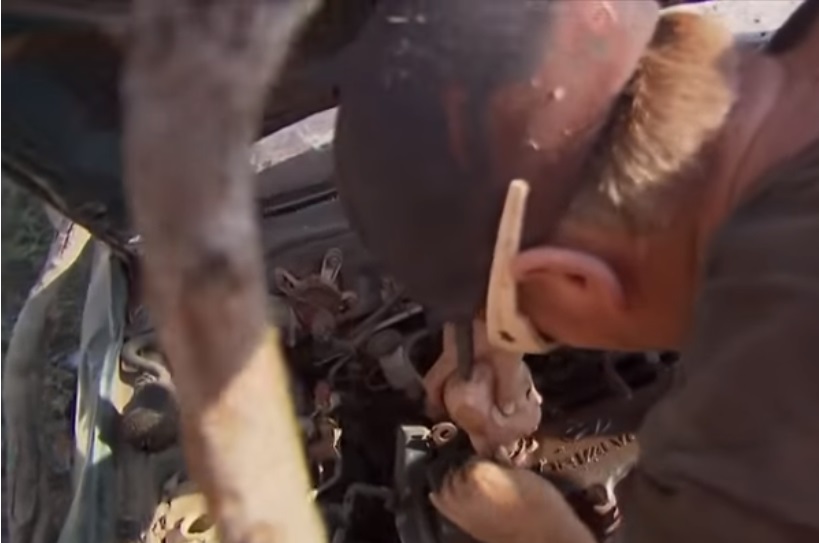
Let’s say your car starts to shake a little bit.  Your cousin, who isn’t a mechanic, tells you that he had the same problem once and he fixed it by driving really fast for a while.  Whatever it was started knocking louder and louder the faster he drove until finally something popped.  His car quit shaking and he hasn’t had a problem with it since.

Working on car

Thanks cuz!

Most people I know would not follow your cousin’s advice, even if they don’t know too much about car repair.  On the surface, it would seem like you should.  You know him, so he probably isn’t lying, and he said he had the exact same problem and he fixed it.  So that should be your answer – but most people I know would ignore him and take it to a professional mechanic.

I think it’s because people are pretty familiar with auto repair.  Either you have a car or you know someone with a car, your parents probably had at least one car.  Cars are a part of our everyday life.  We can’t help but learn a little bit about them.  And we know people that know about cars.  Most of us have tried to fix at least a few things on them, so we have some repairs we feel good about doing ourselves, and other repairs we may trust one or two of our friends with.

But most importantly, we know our limits.  We have a general idea about how much we know about cars and what we can do with it.  So if something gets to complicated, we don’t have too much of a problem getting an actual mechanic (expert) to help us with it.  In fact, most of us go out of our way to find the most qualified, most experienced, most specialized mechanic we can – we don’t just get a mechanic, we get the best mechanic we can.  If we have a Honda, we get a Honda mechanic.  If we have a transmission problem, we get a transmission specialist.  When you find a really good mechanic, you keep that pone number in a safe place.

Senior Airman John Burroughs, a 28th Maintenance Squadron avionics apprentice, works on his truck at Ellsworth Air Force Base, S.D., Aug. 15, 2018. Airmen are welcome to come fix or upgrade their vehicles at the auto hobby shop and take advantage of the other services the mechanics provide. (U.S. Air Force Photo by Airman 1st Class Thomas Karol)

Wow! Gimme your digits

Nothing is perfect – we don’t trust them 100%.  Experts can always be wrong, and we need to make sure we aren’t getting charged for repairs that weren’t done for example.  And we need to make sure we aren’t going to be charged for fixing something that we could really just live with and didn’t need to be fixed.  But we generally rely on what they say and rely on their judgement.  We know we don’t really have a choice.  Ignoring their advice is usually going to be worse for us than taking it.

And if the problem is really serious, we can reduce the chance of error by getting the opinion of more than one expert.  Usually the cost isn’t justified, but for something like whether or not to have a medical operation, you may want a second opinion.  Or a third.  In a perfect world where cost wasn’t an issue, I suppose you would want hundreds of second opinions.   Or thousands.  If you have thousands of experts agreeing, the chance of them being wrong probably approaches zero.  But who has the money for that?

Anyway, we rely on experts when we need help with things we encounter in our everyday life.  Why do we distrust experts for even more complicated things that we have absolutely zero knowledge or experience with?

File:Stonehenge - Image Picture Photography (14884844251).jpg

What does Stonehenge have to do with radiocarbon dating?  I don’t know but I’m sure there is something.  Anyway I like the picture and it’s late.

I’ll give you an example.  I know someone that told me it made no sense to him that scientists thought they could determine the age of something by examining the carbon in it.  He was talking about radiocarbon dating, and he was claiming that it couldn’t possibly work.

My friend had probably spent about 10 seconds learning about radiocarbon dating before he decided it wouldn’t work.  He read an article that had mentioned it being used and that was probably his only exposure to it.  He hadn’t taken any science classes ever that I know of, didn’t read science news, didn’t even really care about science.  I’m pretty sure he didn’t even Google the term.  He literally knew absolutely nothing about it or how it was supposed to work, and yet he had a strong an opinion that it didn’t work.  And if you think about it for just a second – radiocarbon dating isn’t some fringe technique or some brand new technique.  It’s been used and improved since 1949.  It’s relied on by thousands of people across the world for decades.

So whose opinion do you take?  Someone that literally knows nothing, or thousands of experienced experts?  Is that even really a question?  I feel kind of sorry for exposing my friend, but it’s an important point.  The fact that he would have such a silly belief isn’t an indication of his intelligence (or lack of intelligence).  It’s actually just the way our brains work.

If we don’t know enough to know how much we don’t know, we think we know almost everything.  This is something we have probably all run into once or twice.  For example, this is how you can work at a job for 10 years, and have a new guy with zero experience show up and feel like he knows better than you how the job should be done.  If you haven’t run into that problem yourself, you probably know someone else that has.

The ability to think you know a lot about something that you really know nothing about is called the Dunning–Kruger effect.  It’s a pretty well known term and you won’t have any trouble finding it if you want to google the term and read a little about it – I find it interesting.  Everyone is susceptible to it and we all have to pay close attention to what we believe to be sure we aren’t falling under it’s influence.  Maybe you wouldn’t fall for radiocarbon dating – that is kind of an obvious one for many people.  But maybe it’s worth a little self examination to see if there are other topics that you have formed opinions on that were influenced by the Dunning-Kruger effect.

Anyway, that is why I think we rely less on experts when we need them more.  If we know enough to know how much we don’t know, we will be able to call in experts when we need to.  If we know less about something, we tend to think there is less to know and we overestimate our knowledge.  We think we know it all.

The Roles of Faith and Science in Decision Making

ReligionAndScience

Religion and science are often described as being in opposition.  In reality, they are complimentary.  A fact based approach to thinking is better when there are facts to drive the thinking, and a faith based approach works when there are no facts available.

It’s pretty easy to see the benefits of fact based thinking.  We do it every day.  For example when we go to buy a car, hopefully we think through what we need, decide what kind of place we want to buy it from, compare prices, and make the purchase.  We may “accidentally” come home with a red corvette, but if we do we KNOW we have not done things the right way.  If we can manage to make a fact based decision, we will have given ourselves the best chance possible to make ourselves happy in the long run, and we know it.  There isn’t really any room for faith based thinking here.

And it’s pretty easy to see the benefits of faith based thinking too.  Imagine that you are in some life or death situation, and everything you can think of hasn’t worked to get you out of it.  Maybe you are trapped in a wrecked car at the bottom of a ravine and no matter what you try you just can’t get out.  Your phone’s battery is dead, your car’s battery is dead, and you are too far from the road for anyone to hear you.  You have no facts in your favor, nothing to form a plan with that can give you hope of thinking your way out of the problem.  If you rely only on facts, you become helpless.  You have nothing left but faith.  Your survival becomes a waiting game, as you wait for someone to find you.  Without faith, you may be tempted to just give up.  Faith can make a real difference here, and in your day to day life.  You will not always have facts available to guide you.

Both types of thinking are powerful in their own way.  There is no inherent conflict because they both work best in different circumstances.  I think people cause problems for themselves when they use the wrong kind of thinking in the wrong circumstances.

For example, if you are naturally more of a fact based thinker, then you may believe that there is no god because there is no proof of one.  Which is actually very flawed logic and not scientific at all.  You have an absence of fact – you have nothing to support either existence or non existence of a god.  How can you use fact based logical thinking in a situation where there are no facts?

Let me give you, in scientific terms, an example of how wrong this kind of misapplied thinking can be.  Let’s say you were able to go back in time to the 1800’s and talk to one of the scientists there.  And let’s say that you decided to enlighten him on many of the scientific discoveries that have happened in the intervening years.  So you describe black holes, quasars, and DNA to him.  You are not showing him the results of experiments, no real proof – he will only have your word to either believe or disbelieve.  If he insists on making his decision based only on the facts you have shown him, then he would pretty much have to decide that you are crazy or making it all up – and he would have been wrong.  If he allows himself to take a leap of faith and believe your wild stories without any facts, then he would have been right – this time, but he would have opened the door to being lied to in the future.  The most logical way for him to react would have been for him to decide he didn’t have the facts to support making any kind of decision.  Trying to use fact based thinking in the absence of facts would practically force him to come to the wrong conclusion.

It’s the same with faith and religion.  If science sees no facts to either prove or disprove the existence of a god, it doesn’t mean one doesn’t exist.  An equally plausible theory is that a god exists and we just don’t know enough yet to prove it.

An overly strong faith can also cause problems in logical thinking.  One of the best examples I can give you is someone I know that quit her job, cashed in her retirement, and started travelling around the world on it.  When asked what she would do when she had spent everything she owned, she would answer “God will provide”.  Needless to say, when she ran out of money and crashed head first into poverty, she found her faith shaken.  God hadn’t provided.  She would have been better served to have adopted the slogan “God helps those that help themselves”.

You should never use your faith as proof certain facts don’t exist.  That kind of thinking won’t stand the test of time.  For example, Galileo was convicted of heresy for insisting that the earth revolved around the sun, in contradiction to the beliefs of the church.  At the time the church believed the earth was the center of the universe and everything revolved around it.  Who do you know that believes that anymore?  The church’s attempt to ignore facts failed, as it always will.  You can’t just believe the sky to be yellow and have it be so.  Faith gives you an answer when there are no facts, it does not give you an answer in conflict of facts.

Don’t let facts weaken your faith, instead find a way to include the facts you encounter into your beliefs.  Be prepared to reexamine and reinterpret what you know.

For example, dinosaurs.  Many Christians see a conflict between their faith and the existence of dinosaurs.  One perceived problem is that they aren’t mentioned in the Bible – specifically not mentioned in Genesis.  The Genesis account says God created all kinds of animals that walk and crawl on the ground, but didn’t mention dinosaurs.  When you think about it, reptiles and birds weren’t mentioned either, but they obviously exist.  And in thinking about it a bit more, Genesis wasn’t written as a scientific chronology of creation.  It was written for a specific purpose – to let the ancient Israelites understand they were created in God’s image, and that God created them as the crown of his creation.  So you shouldn’t expect it to chronicle everything created, only what it was necessary for the Israelites to understand his main points.  Anything else would have distracted from his message.

When you find facts in conflict with your beliefs, it isn’t really a problem.  Really what has happened is that you have been given an opportunity to deepen your understanding about something.  And that is a good thing.

So use facts to drive your thinking when facts are available, and faith to drive your thinking when they are not.


Science for Non-Scientists

Image result for funny non-scientist

I know…. SCIENCE!!!

What is science?

The simplest explanation is that science is really just an organized way of discovering the truth about things. There are three steps:

  1. Come up with a question that you want an answer to.
  2. Come up with a test to try to figure out the answer.
  3. Remember your answer. And if later, in the future, something makes you think your answer might be wrong or incomplete, then repeat the process by coming up with another question to see if you are right or wrong.

It is really common sense – we all do it every day. Here is an example:

  1. Your friend buys a new car. The door handle is different than any other car you’ve seen. Not sure how to open it.
  2. There is a button on the side – you’ve never seen anything exactly like that before. You think the door might open if you press the button on the side. You decide to try that.
  3. You press the button, and the door opens. If it didn’t, you would go back to step 2 and think of something else.

These three steps that you just did – those are science. The same steps, in the same order. (Just call step 1 a theory and step 2 an experiment).

Interior Design Of A House

Look around you. You can see examples of science that has worked everywhere. The alloys in your car, the light bulbs in your house, your smart phone, your tv, the paint on your walls. I dare you – sit in your living room and slowly look around the room and think about all the discoveries that went into everything you see. You will see hundreds of successful scientific theories put into practice.

So if science is so simple and it works, then how can it go wrong?

Well, like anything else, the simplest way to do something doesn’t always work. What if someone tests the wrong thing but it works anyway – like maybe your friend pressing a button on a remote to open the door when you press the button, which really is just a decoration. You would be convinced the button opened the door, your friend would laugh – and your science would be wrong. Or maybe someone lies to make themselves look better.

So science adds in some rules to try to make sure that less things go wrong with the process. One rule is that the science isn’t really finished until it has been peer-reviewed – which is just a way of saying someone other than you has to be able to look at your work and be sure it makes sense. So, for our example, maybe a car salesman is standing there when you press the button on your friends car door. No matter what nonsense your friend does to mess with you, the car salesman would know enough to keep things honest.

Another rule is that your experiments have to be repeatable. Who knows, maybe something random happened when you pushed the button? You can push it and the door opens but whenever someone else pushes it nothing happens. Well then the button doesn’t really open the door. Something else is going on – who knows what. But the result is that your experiment isn’t valid if it can’t be repeated, so we can’t really say we learned that pressing the button opens the door.

This peer reviewing can take years. Sometimes it prompts many discussions, different scientists have different opinions about how the science was done or what it means, sometimes new experiments are derived to prove this or that theory about what was initially done – this process of making sure that we understand and agree on what we have discovered can grind on for a while.

In order to start the peer review process, scientists publish their work in papers. This is announcing to the world that they have found something interesting and are ready to have their work reviewed. This is generally the exciting part of science, but it is really more the beginning of the process than the end.

Man Sitting on Floor

Show me your SCIENCE!!!

Pause right here. It is VERY important to realize that new scientific discoveries are exciting but not very accurate. Science is really a long process, and the more time and effort spent on a discovery after it is initially announced, the more accurate it will be.

So that gives us a problem – new, unchecked science makes a better news story. So that is what gets reported as science more often in the general media. People get more half baked, incorrect ideas about science than they do real, proven science. And most people don’t know that there are these different levels to science – but there is obviously a huge difference in the accuracy of a discovery just happening and a discovery that has been checked, reviewed, duplicated, and expanded on for 30 years.

Another problem is that the only way to prove yourself as a scientist is to publish papers. Otherwise, other scientists really have no way of knowing for sure what you are working on and how good your work is. This impacts your ability to get jobs, and to keep jobs. In fact, scientists have a saying – “Publish or Perish”. Which goes to show just how important these published papers are to their careers. This leads to a lot of pressure to publish maybe even before your science is solid, or to try to get some publicity. There is too much of a focus on publishing, and sometimes not enough on actual science.

So sometimes, scientists cheat. They make up data or they deliberately interpret their data in the wrong way to make their results sound more important. Or sometimes they try to publish something and make it sound much more exciting and important than it really is, because they want to attract the attention of the news media and try to get some free publicity.

Pink Panther Plush Toy on Brown Bench Miniature

Why did I believe that science story before it was peer reviewed?


Yet one more problem with science is that it can sometimes be bought.  For example the tobacco industry paid for research to support the idea that tobacco wasn’t bad for you.  Either experiments were staged to produce the results the industry wanted, or the data that the experiments produced was misinterpreted.  It doesn’t happen very often, and usually only to support large organizations with a lot of money.  A little googling can sometimes reveal who paid for a given study.  Even if you can’t definitively find the source of funding, you should generally be cautious when deciding to believe science that supports an industry with a lot of money.  You have to be careful that the research is impartial.

All of this doesn’t matter in the long run, because remember – scientists review each others work, ask questions, validate the way things were done, and repeat experiments. If the work is rushed, faked, or just wrong it will definitely be found out. But not before it has potentially gotten reported as news.

Another thing to realize is that science is never finished. Science believes in always questioning, so once something is discovered it isn’t just blindly accepted. New ways are found to check it to see if what is generally believed is still correct, and follow on discoveries are attempted. Just because science doesn’t know 100% about something doesn’t mean science knows nothing. So when an idea is changed it means we are learning, not that we were wrong.

For example, a long time ago we were told eggs were healthy. Then we were told they weren’t. Then we were told they were, and the last time I checked they are supposed to be unhealthy again. It doesn’t mean we don’t understand nutrition at all. It means we are learning about nutrition. When we were initially told eggs were good for you, our understanding of nutrition was rather simple. I think it was basically that we need to eat or we die, and eggs tasted good – so eat them. Then we learned about cholesterol and we were told not to eat them because they were high in cholesterol. Then we discovered that sugar was a huge health risk that we hadn’t accounted for – probably more important than cholesterol. That was when we were told not to worry about cholesterol – eggs are good for you. They didn’t have any sugar, so eat them… and then we were told not to eat them because the particular kind of cholesterol eggs contain is bad for you. But we said that because we learned more again. So we never stopped learning about eggs. We were always questioning and reexamining what we thought we knew, and improving it.

You could just look at the back and forth on eggs and decide science is incapable of producing any kind of information you can actually use. But you would be making your decision based only on one part of what science taught us – eggs. Instead of looking at the whole picture, you would just be looking at a single failure.  If you looked at the whole picture – at how much we knew about all of nutrition at each of those points instead of just eggs, you would see something different. At each point, if you followed all of the scientific advice about nutrition that was accepted at the time, you would be healthier than if you ignored all of it.

So pause again for a second. This is another important point. Science will never give us answers that are 100% right. But that is different than science being 100% wrong.

Science works. If you doubt it, just look around your living room again. Over time, science has produced many more successes than failures. Your living room exists because of the success of science. If science failed more often than it succeeded, then you wouldn’t have a living room. Those discoveries you see wouldn’t have happened, and we would all be living in caves and killing our dinner with our bare hands.

So here is the summary –

  • Science is really just common sense with rules and it works.
  • You are usually better off with science than without it.
  • If you see a new exciting news story, watch it. It’s probably interesting. Just know that it may be fake or incorrect or just not as important as it seems – treat it as entertainment.
  • Once a discovery has been peer reviewed and the experiments verified, it is much more likely to be correct. In fact it is almost always at least partially correct. It is no longer entertainment – it’s news.
  • Science is a long process and gets better over time, and the chance of it being completely wrong diminish each time it is peer reviewed.